
Grid codes, decoded — The EU rules that are finally coming for EV chargers
ACER is proposing the first dedicated grid connection rules for EVs and chargers. Here's what FRT, LFSM-UC, and RoCoF mean in practice — and why the industry isn't waiting for Brussels to catch up.

Every time an EV plugs into a charger, it draws power from the grid. Now multiply that by tens of millions of vehicles. Add heat pumps, solar panels feeding energy back in, and factories running heavy machinery — all connected to the same electrical system. How does the grid not collapse?
The answer: grid codes. These are the rulebook that every device connected to the electricity grid must follow. And yet, in the EV charging industry, very few people truly understand what they are, how they work, and why they’re about to become a lot more relevant.
In this article, I’ll explain what grid codes actually are, why they exist, what the key technical requirements look like (with concrete examples you can actually understand), and what’s changing with the upcoming amendments to the European Demand Connection Code — a regulation that directly impacts EV chargers and electric vehicles.
Grid codes are building codes — for the electricity grid
Think of grid codes like building codes for a city’s electrical infrastructure. Just as building codes ensure that every structure can withstand earthquakes, support certain loads, and meet fire safety standards, grid codes ensure that every device connected to the electricity grid behaves in a way that keeps the system stable and safe.
Without building codes, one poorly constructed building could collapse and damage its neighbours. Without grid codes, one misbehaving device — or millions of them — could destabilise the entire electricity system.
Grid codes define the technical rules that equipment (like EVs and charging stations) must follow to connect to and operate on the electricity grid. They cover things like:
What voltage and frequency ranges equipment must tolerate without disconnecting
How equipment must behave during grid faults (e.g. a short circuit on a transmission line)
What power quality standards equipment must meet
What information must be exchanged between the equipment owner and the grid operator
These aren’t guidelines or recommendations, they’re binding regulations. Grid codes exist in every country.
In this article, we’re focusing on the European grid code regulation as there are important changes underway that will help harmonise the integration of EVs and chargers into the European electricity grid across all member states.
The European grid code family
Europe has developed a comprehensive set of grid codes under the Third Energy Package. The three core connection codes are:
Requirements for Generators (RfG): Commission Regulation (EU) 2016/631. Covers power plants, wind farms, solar parks — anything that generates and feeds electricity into the grid.
Demand Connection Code (DCC): Commission Regulation (EU) 2016/1388. Covers everything that consumes electricity from the grid: factories, buildings, EV chargers, heat pumps, data centres — all demand-side equipment.
High Voltage Direct Current Code (HVDC): Commission Regulation (EU) 2016/1447. Covers HVDC systems and the DC-connected power park modules used in subsea cables and long-distance interconnectors.
Together, these codes form a coherent regulatory architecture. Generators, consumers, and interconnectors each have their own rulebook — but all three are designed to work in harmony to keep the grid stable.
For EV charging, the relevant code is the Demand Connection Code.
The Demand Connection Code: what it covers
The DCC, formally Commission Regulation (EU) 2016/1388, was adopted in August 2016. It establishes harmonised technical requirements for connecting demand facilities to transmission and distribution networks across the EU. In plain English: it defines the technical minimum standard that any electricity-consuming equipment must meet to be allowed onto the grid.
The DCC applies to:
Transmission-connected demand facilities: large industrial consumers connected directly to high-voltage transmission networks
Distribution-connected demand facilities: anything connected to the lower-voltage distribution grid, including commercial buildings, EV charging sites, and residential connections above certain thresholds
Closed distribution systems: private networks like airports, ports, or large campuses
Demand units providing demand response services: equipment that actively participates in grid balancing (though this is changing — more on that below)
So where does EV charging fit in? EV chargers are demand facilities connected to the distribution grid. As charging infrastructure scales up — large charging hubs with dozens of high-power chargers drawing hundreds of kilowatts — these installations become significant grid assets. The grid code ensures they play by the rules.
Grid codes in practice: what the technical requirements actually look like
This is where most explanations of grid codes lose people. Let me try to make this tangible with concrete examples from the DCC.
Frequency: staying in the safe zone
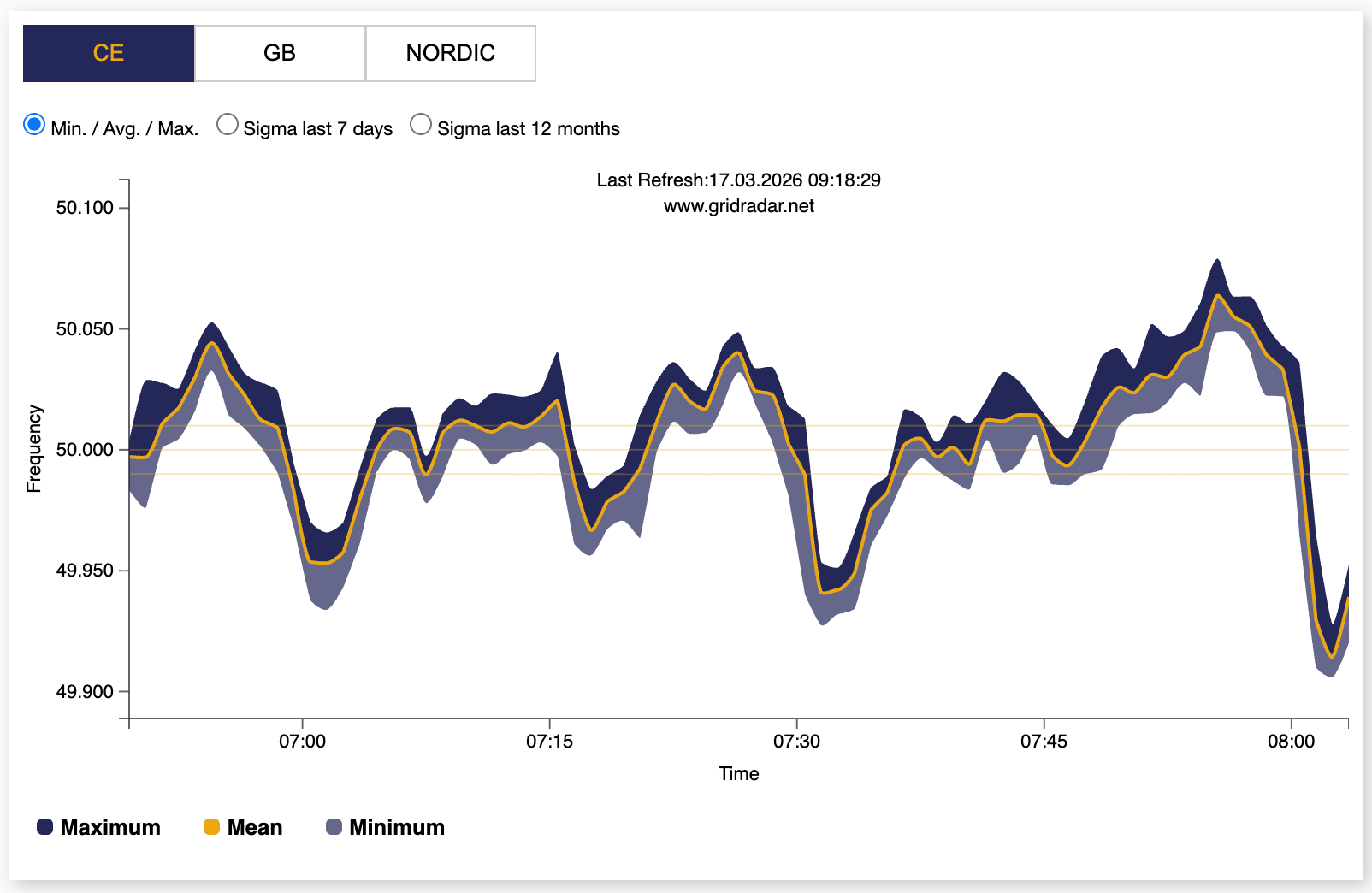
The European electricity grid operates at a nominal frequency of 50 Hz. This frequency is a direct indicator of the balance between electricity generation and consumption across the entire interconnected system. When supply and demand are perfectly matched, frequency sits at 50.00 Hz. When demand exceeds supply (more power consumed than generated), frequency drops. When supply exceeds demand, frequency rises.
The DCC requires demand facilities to remain connected and operational across a frequency range of 47.5 Hz to 52.0 Hz. That might sound like a small window, but in grid terms, even a 0.5 Hz deviation from 50 Hz signals a serious imbalance.
Think of grid frequency like a resting heart rate. A healthy grid beats at exactly 50 Hz. A drop of just 0.5 Hz — one percent — already signals a serious imbalance. A drop to 47.5 Hz is a full-blown emergency. It’s like a resting heart rate that’s supposed to sit at 60 bpm — if it dips to 57, most people wouldn’t worry. But the grid is far less forgiving. In grid terms, that same 5% deviation is the difference between normal operation and the threshold where equipment is allowed to disconnect. Every fraction of a Hertz matters. The grid code says: your equipment must stay connected and ride through these events, not trip and disconnect — because mass disconnection of loads would make the problem worse, not better.
You can actually trace the current and past frequency of the European, British, and the Nordic electricity grid at Gridradar.
Voltage: keeping it within bounds
The DCC also specifies voltage requirements. Equipment must remain connected and operational across a voltage range of 0.85 pu to 1.10 pu at the connection point. The unit “pu” stands for per unit — it’s a normalised way of expressing voltage relative to the nominal value. So 1.0 pu = nominal voltage (e.g. 230V for low-voltage or 400V for three-phase), 0.85 pu = 85% of nominal, and 1.10 pu = 110% of nominal.
Why does voltage fluctuate? Every time a large load switches on or off — a factory starting a production line, a charging hub ramping up — the local voltage dips or rises. The grid code says: your equipment must handle these fluctuations without tripping. If your EV charger shuts down every time the voltage dips to 210V (0.91 pu), that’s a problem.
Fault Ride-Through: don’t abandon ship
Fault Ride-Through (FRT) is one of the most important and least understood grid code requirements. Here’s the scenario: a tree falls on a transmission line, causing a short circuit. The voltage at the fault point drops to near zero. This voltage dip propagates through the network, reaching your EV charging hub as a brief but significant voltage drop.
The old behaviour of connected equipment was simple: detect low voltage, disconnect, protect yourself. But when millions of devices all disconnect simultaneously during a grid fault, the sudden loss of load creates a massive imbalance that can cascade into a wider blackout. That’s exactly what grid codes are designed to prevent.
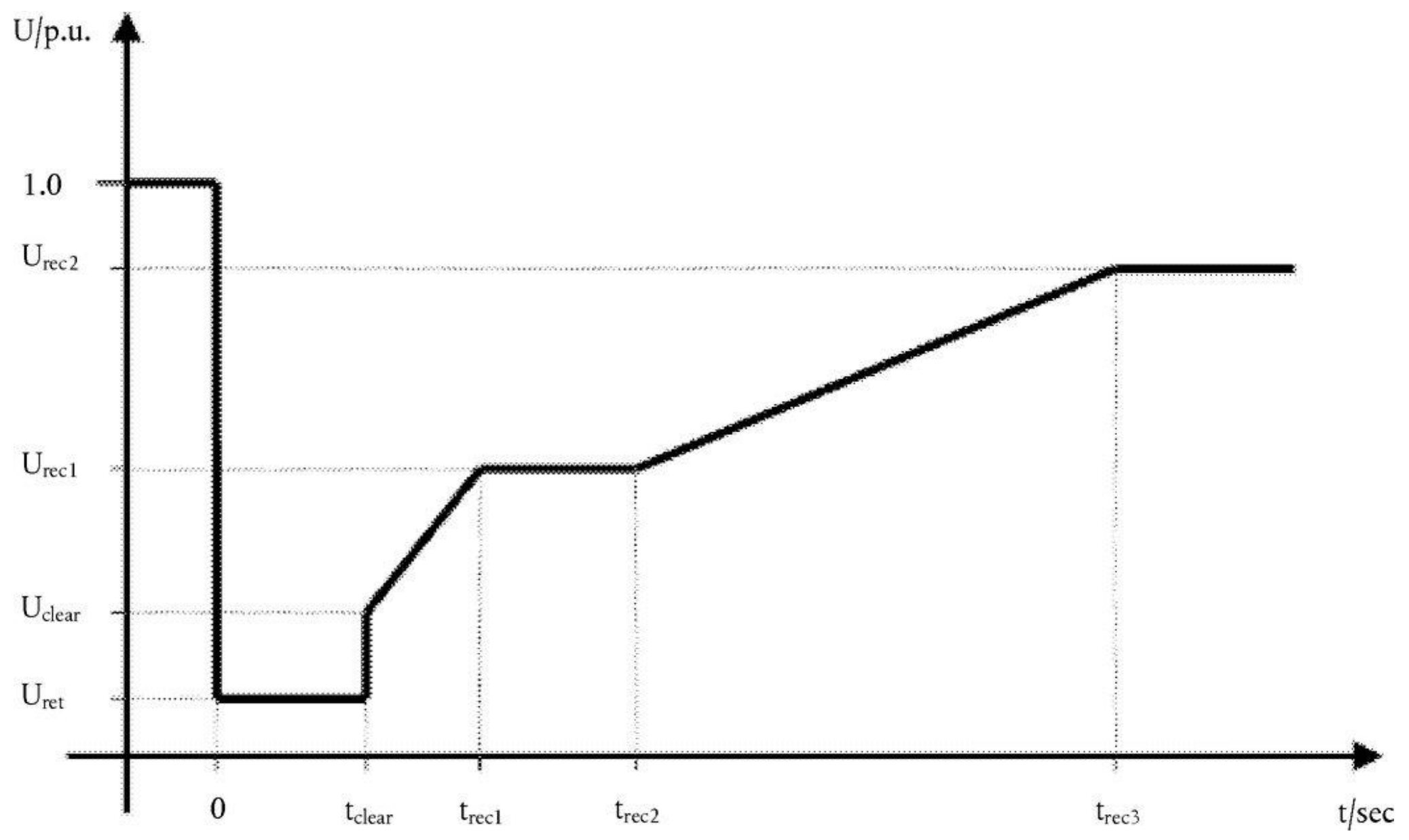
FRT requires equipment to remain connected during short-duration voltage dips — riding through the fault rather than disconnecting. The DCC defines a voltage-against-time profile: how deep the voltage can drop and for how long the equipment must stay connected.
Under the proposed ACER (EU Agency for the Cooperation of Energy Regulators) amendments to the DCC, there will be a harmonised, binding FRT profile specifically for EV chargers, V1G electric vehicles, heat pumps, and power-to-gas units. This means a single European-wide standard — no more varying national requirements. Manufacturers can design one product that works everywhere.
The diagram shows the minimum voltage behaviour required at the connection point during and after a grid fault, expressed as a fraction of normal voltage (1.0 pu). Voltage drops to U_ret when the fault strikes and holds there until the fault is cleared at t_clear. Recovery then happens in stages: voltage rises to U_rec1 by t_rec1, briefly plateaus, then climbs to U_rec2 by t_rec3. Equipment must remain connected for any voltage path that stays on or above this curve.
The voltage parameters (in pu, i.e. per unit — see above) for the fault-ride-through capability of V1G (unidirectional charging) EVs and associated EV chargers are:
U_ret: 0.05
U_clear: 0.15
U_rec1: 0.15
U_rec2: 0.85
The time parameters (in seconds) are:
t_clear: 0.15
t_rec1: 0.15
t_rec2: 0.15
t_rec3: 3.0
LFSM-UC: automatic power reduction when the grid is stressed
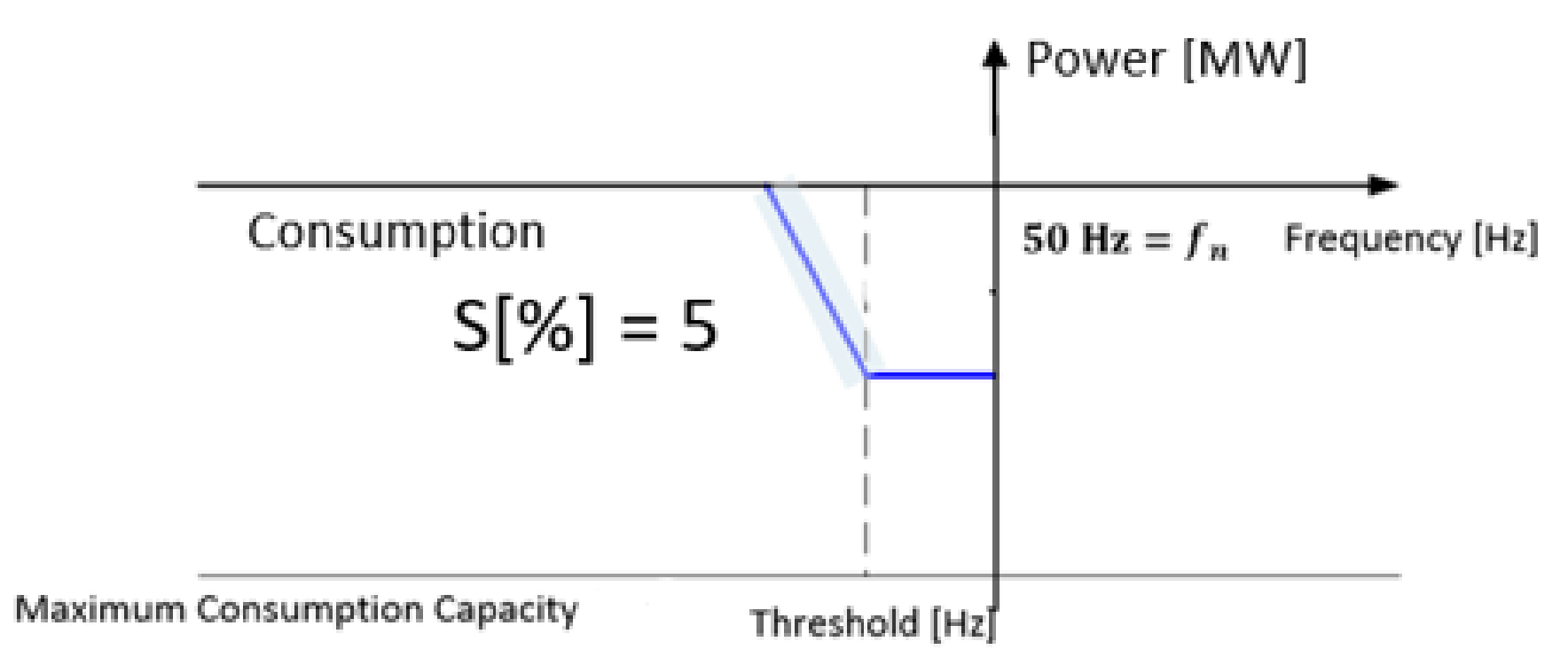
Limited Frequency Sensitive Mode – Underfrequency Control (LFSM-UC) is a requirement for certain demand equipment to automatically reduce its power consumption when grid frequency drops below a threshold. This is particularly relevant for EV chargers.
Here’s how it works for EVs, chargers, and power-to-gas units under the proposed amendments:
Frequency threshold: 49.8 Hz (or 49.5 Hz for the Irish and Nordic synchronous areas)
Droop setting: 5% — this defines how aggressively power is reduced per Hz of frequency deviation
Response time: 0.5 seconds or less
When frequency drops below 49.8 Hz, the charger must automatically reduce its power consumption, scaling down proportionally until it reaches its minimum operating level
If the minimum operating level exceeds 20% of rated power, the unit must disconnect entirely
After disconnection, a random reconnection delay of up to 5 minutes prevents all devices from reconnecting simultaneously (which would cause a second frequency dip)
Think of this like a thermostat for the grid. When the system is under stress (frequency dropping), every connected device needs to ease off — automatically, without waiting for a human command. Your EV charger might slow down from 11 kW to 6 kW for a few minutes. You probably wouldn’t even notice, but multiplied across millions of chargers, that reduction can prevent a blackout.
RoCoF: riding out rapid frequency changes
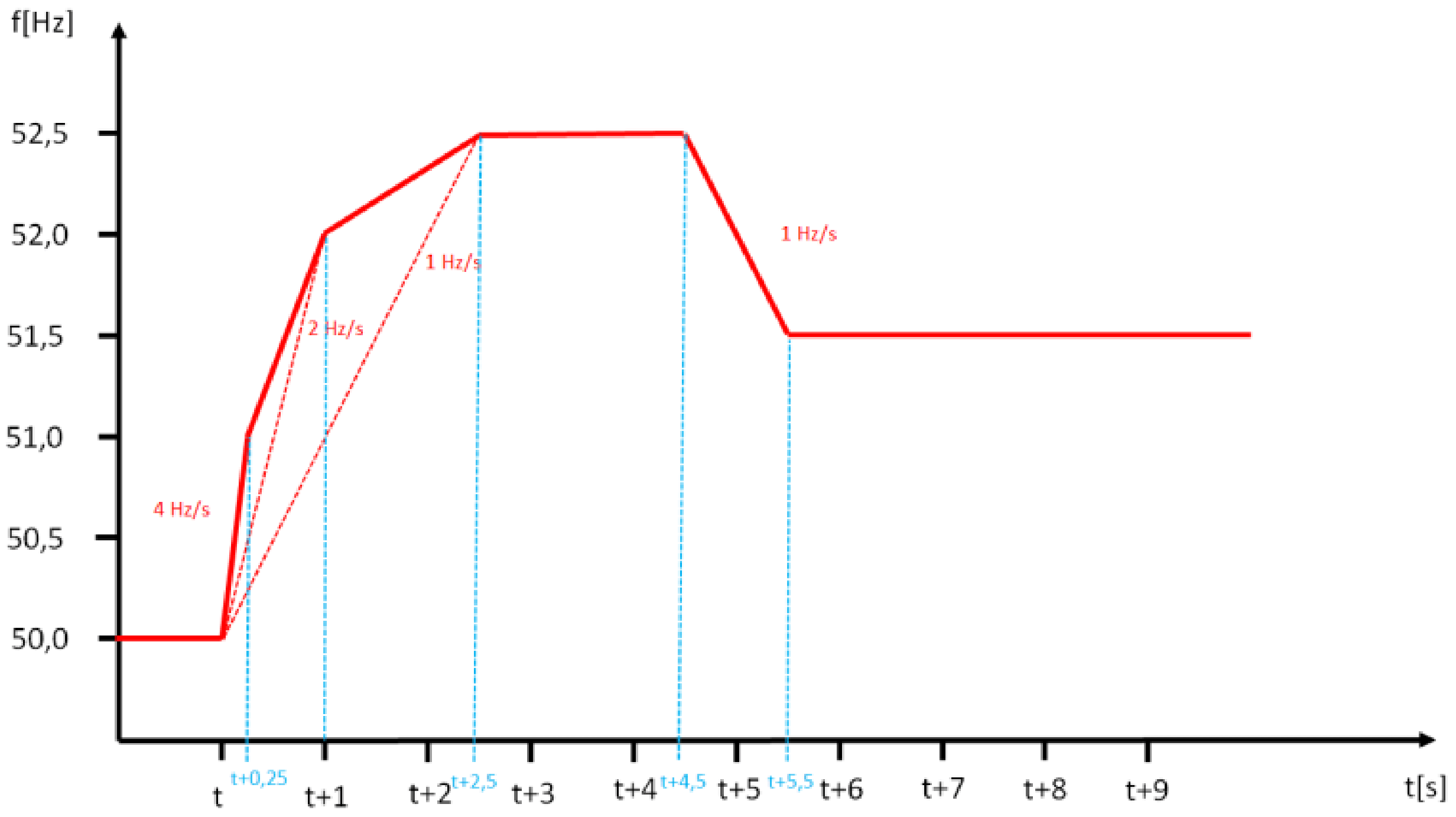
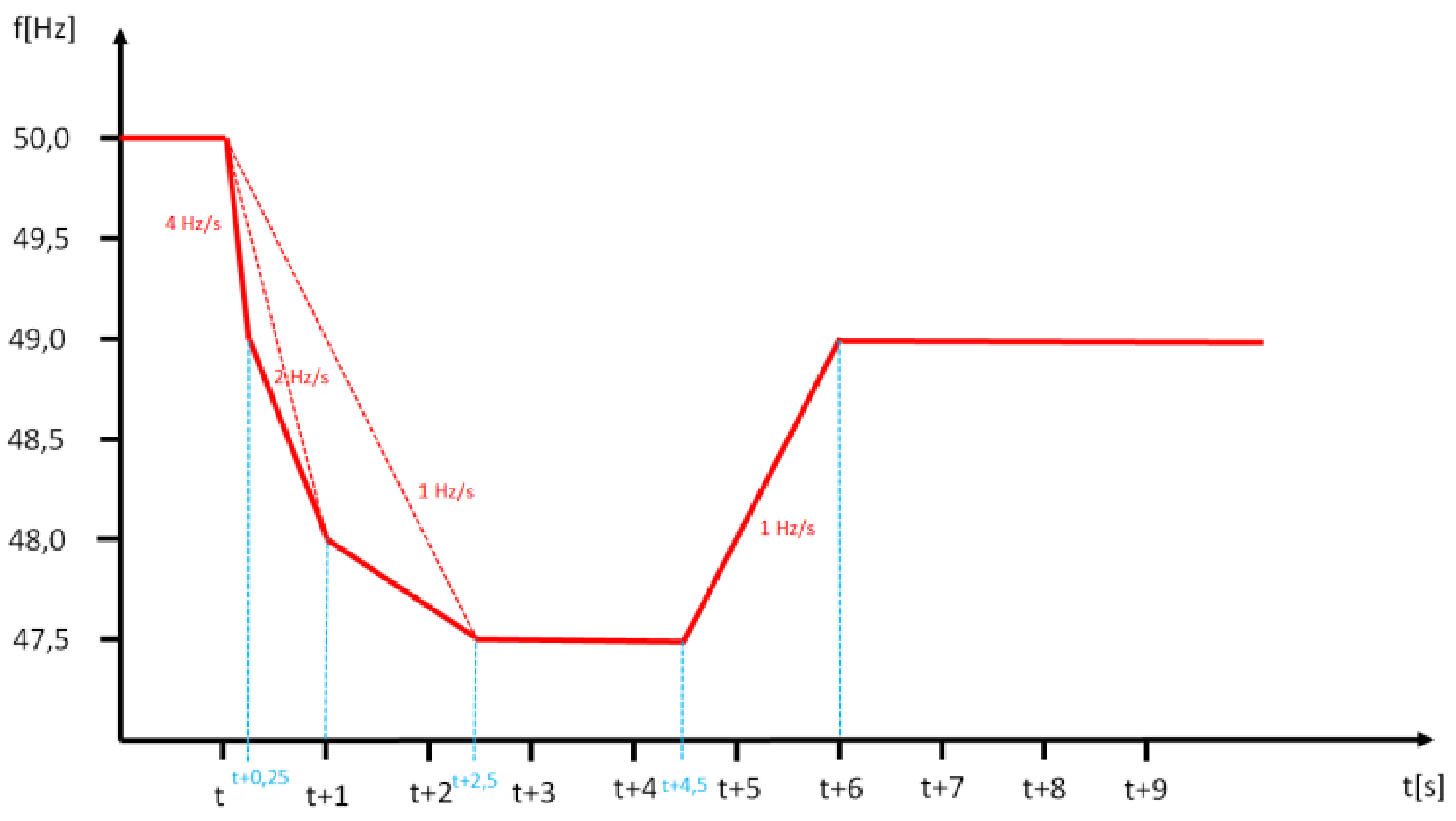
Rate-of-Change-of-Frequency (RoCoF) measures how quickly the grid frequency is changing — expressed in Hz per second. During sudden imbalances (e.g. a large power plant tripping offline), the frequency doesn’t just drop — it drops fast. Equipment must be able to withstand these rapid changes without disconnecting.
The proposed DCC amendments specify binding RoCoF withstand values for EVs, EV chargers, and heat pumps:
±4,0 Hz/s over a period of 0,25 s
±2,0 Hz/s over a period of 0,5 s
±1,5 Hz/s over a period of 1 s
±1,25 Hz/s over a period of 2 s
The faster the frequency change, the shorter the equipment needs to withstand it — but it must not disconnect during these transients. This is a new, harmonised EU-wide requirement that replaces previously varying national specifications, giving manufacturers a single design target.
What’s changing: the ACER amendments and why they matter
ACER submitted Recommendation 03-2023 to the European Commission in December 2023, covering amendments to two of the three grid connection regulations: the Requirements for Generators (RfG) and the Demand Connection Code (DCC).
The RfG — which covers power plants, wind farms, and anything that generates electricity — was written in 2016, before EVs and battery storage became serious grid players. ACER’s proposals bring them into scope: updated definitions to reflect today’s technology mix, a process for modernising older generation equipment rather than forcing it through the full new compliance regime, and dedicated technical requirements for EVs, EV charging parks, and electricity storage modules.
The DCC proposals follow the same logic on the demand side: expand scope to include EVs, EV chargers, heat pumps, and power-to-gas units (none of which featured meaningfully in the 2016 original), create a similar modernisation pathway for existing connected facilities, and introduce updated technical requirements for transmission-connected demand facilities and distribution systems.
This article focuses on the DCC. Within those amendments, the most significant structural change is a separation of concerns:
The DCC retains all technical connection requirements — the rules your equipment must meet to physically connect to the grid (frequency, voltage, FRT, RoCoF, etc.)
Service-related provisions (demand response participation, flexibility market access, aggregation) are being moved out of the DCC and into the System Operation Guideline (SO GL) and the forthcoming Network Code on Demand Response (NC DR)
Why does this matter? Because it creates a clean distinction between two things that were previously tangled together:
Grid-compliant: your equipment meets the baseline technical connection standards. It can safely connect to the grid.
Grid-service capable: your equipment has enhanced functionalities — it can actively participate in frequency support, demand response, and flexibility markets.
For EV charger and vehicle manufacturers, this is significant. The amended DCC explicitly includes V1G (uni-directional charging) electric vehicles and EVSEs (Electric Vehicle Supply Equipments, i.e. charging stations in DCC terminology) for the first time as a distinct category with dedicated technical requirements. You’ll know exactly what your product must do to be grid-compliant across all EU Member States — and anything beyond that (like participating in flexibility markets) is governed by a separate regulation.
This is also the first time the DCC introduces harmonised, binding technical requirements (FRT, LFSM-UC, RoCoF) for EV/EV chargers that override national variations. One set of rules. One compliance target. One product for the whole EU market.
What the EV charging industry should do now
This isn’t a distant regulatory exercise. The amendments are being finalised, and manufacturers, charge point operators, and facility owners need to start preparing:
Manufacturers: verify that your hardware and power electronics can meet the harmonised FRT, LFSM-UC, and RoCoF requirements. Start preparing compliance documentation — certificates and Demand Unit Documents (DUDs) will be required for equipment connected above 1,000V.
Charge point operators: assess your existing charging sites against the new technical thresholds. Early compliance avoids costly retrofits.
Facility owners: understand the separation between connection compliance (mandatory) and market participation (optional). Plan your investments accordingly.
Important caveat: The ACER amendments described in this article are currently at the recommendation stage — they are not yet adopted EU law. ACER submitted its Recommendation 03-2023 to the European Commission in December 2023, proposing amendments to both the RfG and DCC. A separate Recommendation 01-2025 on the new Network Code on Demand Response (NC DR) followed in March 2025. The Commission must still run its comitology process (Member State vote) before adoption — no date has been set. Once published in the Official Journal, moreover, most technical requirements don’t apply immediately: Article 59 of the draft specifies they take effect three years after publication. As an EU Regulation rather than a Directive, there’s no national transposition step — it applies directly in all Member States — but that built-in lead time means manufacturers and CPOs wouldn’t face compliance obligations until around 2030 at the earliest. You can read the full proposed amended DCC text in Annex 2 of ACER Recommendation 03-2023, and the original Demand Connection Code on EUR-Lex.
None of this means the industry is standing still waiting for the regulation to catch up. Commercial V2G (Vehicle-to-Grid, bidirectional charging) — far more technically demanding than V1G — is already live in Europe: in France (Renault Mobilize and The Mobility House), Germany (BMW and E.ON, and Octopus Energy with Ford), and the Netherlands (the Utrecht Energized V2G car-sharing fleet). These work through bespoke arrangements with individual utilities and grid operators, negotiating existing national codes project by project.
What the DCC amendments would change is not whether V1G or V2G can happen — clearly they already can — but whether they can scale across all 27 EU member states without every deployment requiring its own regulatory workaround.
On EU regulatory speed. Macron himself acknowledged at Davos that Europe is “sometimes too slow, for sure, and needs to be reformed, for sure“ (see min 21:45). The ACER amendment was submitted in December 2023. It might be adopted in 2027. Under Article 59 of the draft, technical requirements then apply three years after publication — so mandatory compliance is realistically closer to 2030. That’s seven years from proposal to enforcement — not exactly a speedy process, for sure (it’s worth watching this amusing video, here’s the context for the uninitiated 😁).
Much of the technical analysis in this article draws on an excellent white paper the CharIN Focus Group Grid Integration & Energy (in collaboration with P3 Group) released end of February: ACER’s amendment proposals for the European Grid Codes (2026). It provides a detailed, EV/EVSE-focused breakdown of the proposed DCC amendments and is well worth reading if you want to go deeper.
The bottom line
Grid codes are invisible to the end user — and that’s exactly the point. They’re the rules that keep the lights on when millions of devices are pulling power from the same system. As EV charging infrastructure scales, these rules are becoming more specific, more harmonised, and more relevant to our industry than ever.
The ACER amendments to the Demand Connection Code mark a turning point: for the first time, EV chargers and electric vehicles have their own dedicated set of EU-wide technical requirements. One standard. No national patchwork. That’s good for manufacturers, good for operators, and good for the grid.
The grid doesn’t care about your brand or your business model. It cares about physics. And grid codes are how we make sure physics wins.
You may wonder: but what about grid codes for V2G? And what role does OCPP and ISO 15118 play in relation to these grid codes? That, my dear friend, is a story for future articles. So stay tuned and watch out for more grid code / V2G related news in the coming weeks and months (and subscribe, if you haven’t done so yet).