

In November 2025, the German Parliament quietly removed one of the biggest commercial obstacles to Vehicle-to-Grid: the double taxation of electricity that had been charged twice when an EV fed power back to the grid — once when stored, once when discharged. BMW and E.ON launched Germany’s first commercial V2G service, making the full package — wallbox, smart meter, and energy tariff — available to order in February 2026, following their announcement at IAA Mobility in September 2025. Ford and Octopus Energy announced their own residential V2G programme the same month, with the service due to go live in Summer 2026. Of the 1.65 million registered EVs in Germany, only around 10% are currently capable of bidirectional charging according to EnBW Energy Ventures. That number is about to move fast.
Here is the part that matters for grid stability: when a BMW iX3 feeds 11 kW back to the grid at six o’clock in the evening, it is no longer just a car. It is a generator. And generators do not play by the same rules as consumers.
In the previous article, I covered the Demand Connection Code (DCC) — the EU rulebook for devices that consume electricity from the grid. Fault Ride-Through, LFSM-UC, RoCoF: those requirements govern EV chargers as so-called demand facilities. The moment an EV discharges energy back into the grid, a completely different regulation takes over: the Requirements for Generators (RfG), Commission Regulation (EU) 2016/631.
In this article, you’ll learn what changes the moment your EV starts feeding power back to the grid, and what that means for the standards, protocols, and certifications shaping V2G today:
Why AC and DC V2G have fundamentally different compliance architectures, and who is responsible for grid code certification in each case
What the Requirements for Generators (RfG) demands from a V2G unit: frequency response, interface protection, and reactive power control
How national grid codes in Germany, the Netherlands, and the UK differ — and why they are slowly converging
AC or DC? The answer determines who gets certified
Before getting into what the grid codes require, there is an architectural question that changes everything: where is the inverter?
V2G requires converting between DC (Direct Current, the format in which a battery stores energy) and AC (Alternating Current, the format the grid runs on). The inverter is the device that does this conversion. In normal charging it runs in one direction; in V2G it must run in both. The critical question is where that inverter physically sits, and the answer differs between AC and DC V2G.
DC V2G (CCS DC, CHAdeMO): the inverter is built into the charging station. When the session reverses, it is the charger’s inverter that handles DC-to-AC conversion and connects to the grid. Grid code compliance — frequency response, reactive power control, interface protection — is the responsibility of the charging station manufacturer. The EV contributes its battery and nothing else. The Ford Explorer and Ford Capri are DC V2G vehicles: they connect via CCS Combo 2 to the Ambibox ambiCHARGE DC wallbox, which carries the inverter and bears the compliance burden.
AC V2G (Type 2 AC bidirectional, as used by the Renault 5, for example): the inverter is the EV’s own on-board charger (OBC). It already converts AC from the grid into DC to charge the battery. For V2G, it must also run in reverse: DC from battery back to AC into the grid. That means grid code compliance for the inverter functions is the responsibility of the vehicle manufacturer — but, as we will see, the charging station carries its own compliance obligations too.
In DC V2G, a charger manufacturer can build and certify a grid-compliant charging station independently of any specific vehicle. In AC V2G, the EV manufacturer must ensure the OBC meets all generator requirements. And because that inverter is inside the car, it must be certified as part of the vehicle itself.
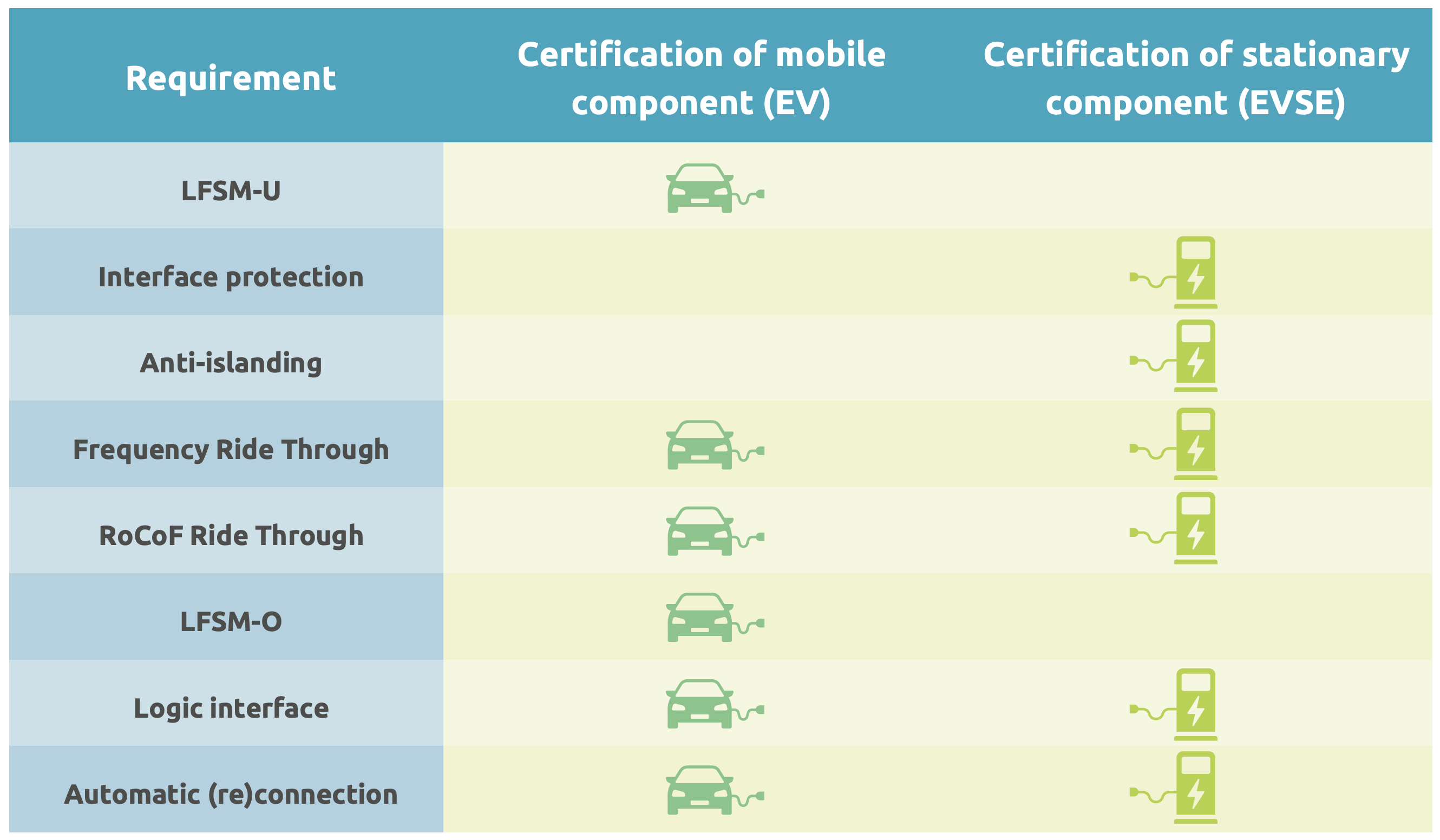
The function split for AC V2G certification flows directly from this architecture. For a complete AC V2G system to be compliant, responsibilities are divided:
The EV must handle: LFSM-U (increasing active power output during under-frequency) and LFSM-O (reducing active power output during over-frequency). These are the inverter functions that restore grid stability — the EV’s contribution to active power control. Quick reminder: LFSM-U stands for Limited Frequency Sensitivity Mode – Underfrequency, and the “-O” stands for Overfrequency.
The charging station must handle: interface protection (automatic disconnection when voltage or frequency exceeds safe limits) and anti-islanding (detecting and disconnecting from an unintentionally isolated section of the grid). These are the grid protection functions, which are the EVSE’s responsibility, not the vehicle’s.
Both must handle: Frequency Ride Through (staying connected during frequency deviations), RoCoF Ride Through (staying connected during rapid frequency changes), logic interface, and automatic (re)connection. And critically: the communication link. The EV inverter must stay connected during a voltage dip, but so must the ISO 15118-20 session running over the charging cable. If the charging station drops its Power Line Communication (PLC) session during a fault event, the EV loses its control signals and may trip off regardless of what its inverter would otherwise do. Ride-through is a system requirement, not just an inverter requirement.
The generator rulebook
When a V2G unit discharges to the grid, it falls under the Requirements for Generators (RfG), EU Regulation 2016/631. The RfG sets the principles: generating plants must meet certain technical requirements to connect. For the actual numbers — voltage thresholds, frequency ranges, protection settings — it points to European standards. Understanding the layering matters, because these three instruments are frequently conflated:
RfG is the EU legal instrument. It is the law that states “generating plants must comply with technical connection requirements.” It applies across all EU member states and cannot be overridden at national level. But it deliberately avoids specifying every parameter. Instead, it delegates specifics to European standards.
EN 50549-1 (a CENELEC standard) is where those specifics live for distribution-level generators at low voltage (≤1 kV). This covers most residential and commercial V2G: a BMW iX3 or Ford Explorer on a home wallbox, a Renault 5 fleet depot, a neighbourhood V2G hub. EN 50549-2 covers medium voltage (1–35 kV), relevant for larger fleet installations.
EN 50549-10 is the test standard. To prove compliance with EN 50549-1, you need a formal test report based on EN 50549-10. This is the compliance verification document. Without it, you cannot certify your V2G unit as grid-compliant.
ACER’s proposed amendments to the RfG introduce three dedicated V2G categories within this framework: EV1 (0.8–2.4 kW), EV2 (2.4–50 kW), and EV3 (50 kW–1 MW), with proportionate compliance requirements at each tier. Most residential V2G systems — Ford/Octopus at 11 kW, BMW/E.ON — fall into EV2.
V2G frequency response when discharging power
In the previous article, I explained LFSM-UC (Limited Frequency Sensitivity Mode – Underfrequency Control): when grid frequency drops below 49.8 Hz, V1G chargers must automatically reduce consumption to help stabilise the grid (5% droop). The “C” is deliberate — it is the demand-side variant, defined in the Demand Connection Code for units that control their consumption; the generator-side equivalent in the RfG drops the C and is simply called LFSM-U. V2G adds the mirror image, and it’s more demanding.
When frequency drops, a V2G unit must not just reduce consumption. It must increase discharge, i.e. act like a generator ramping up output to rescue the grid. The droop setting for this response is 2% — the value mandated by VDE 4105 and ElaadNL, and the tightest end of EN 50549-1’s 2–12% range.
“2% droop” sounds abstract. Here is what it means in practice.
Most electricity grids run at exactly 50 Hz (with the exception of e.g. the US, which runs on 60 Hz) because that frequency is what keeps generators, motors, and devices in sync. It is a constant tightrope walk between how much power is being generated and how much is being consumed. When demand spikes — everyone’s kettle on at half time — frequency starts to fall. Left uncorrected, that becomes a blackout.
V2G units are part of the answer. The moment they detect falling frequency, they discharge more power into the grid — automatically, with no command from anyone. But how much more? That’s what droop defines.
Think of it like a dimmer switch, not a light switch. A regular switch is binary: fully on or fully off. A dimmer gives a graduated response — push it a little, a little more light; push it further, much brighter. Droop makes a V2G unit behave the same way: the further frequency falls below the threshold, the more power it adds. Proportionally. Continuously. Without anyone touching anything.
At 2% droop, that proportionality works out to one simple rule:
For every 0.1 Hz the frequency falls below the 49.8 Hz threshold, the unit increases its discharge by 10% of its rated power.
In practice, for a 7.4 kW V2G unit currently discharging at 3 kW:
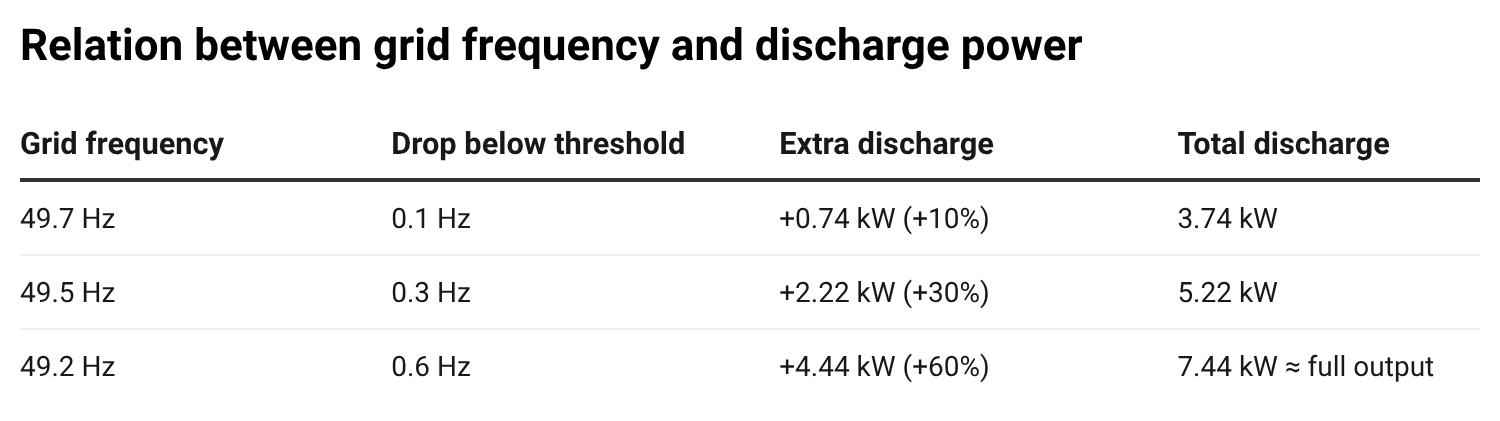
No operator call, no message from a control room. The inverter reads the frequency at the socket, in real time, and adjusts.
The “2%” label comes from the engineering definition of droop, for those who want it:
Plugging in the extreme case: a 1 Hz drop is exactly 2% of 50 Hz, demanding 100% of rated output. The droop setting is designed so the worst realistic emergency triggers maximum response. Everything between zero and 1 Hz scales linearly between those extremes.
The threshold is configurable between 49.5 and 49.8 Hz; the default is 49.8 Hz.
I’ve tried to capture the above in an illustrative example. Here’s the thing: I understand the protocols that carry these parameters better than the power engineering that defines them. If the diagram below is making a grid engineer somewhere reach for a red pen, please do reach out. I would rather be corrected than confidently wrong.
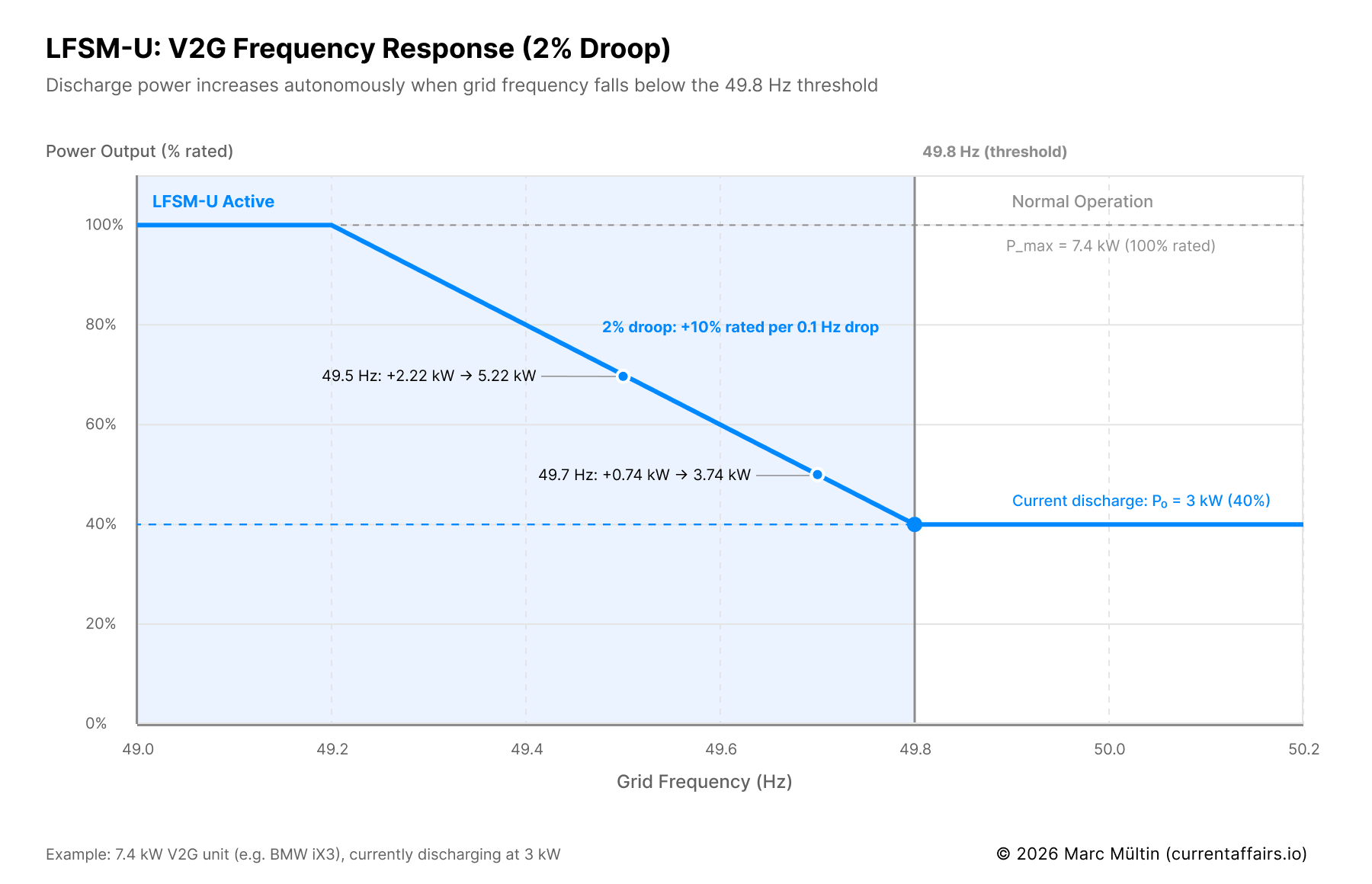
Multiply this across tens of thousands of V2G EVs connected across a country on a winter evening, and that autonomous response aggregates into gigawatts of fast-acting frequency support.
Interface protection: the emergency circuit breaker
Frequency response governs how V2G units behave during normal grid disturbances. Interface protection governs what they do during a full emergency.
When voltage or frequency goes outside safe limits and stays there long enough, the V2G unit must disconnect automatically. Not to protect itself primarily, but to prevent an inverter from continuing to energise a section of grid that may be isolated or under fault. This is the fail-safe that sits behind the ride-through requirements: Frequency Ride-Through says “stay connected through minor events”; interface protection says “when it is a real emergency, get off the grid fast.”
Under EN 50549-1, the disconnection thresholds for units rated between 0.8 and 11 kW are:
UV1 (under-voltage): below 80% of nominal voltage → disconnect within 2 seconds
OV1 (over-voltage): above 110% of nominal voltage → disconnect within 2 seconds
UF1 (under-frequency): below 47.5 Hz → disconnect within 2 seconds
UF2 (over-frequency): above 51.5 Hz → disconnect within 2 seconds
For units above 11 kW, there is an additional, faster threshold: UV2 at 70% of nominal voltage → disconnect within 0.2 seconds. The reasoning is proportionate: a higher-power unit can cause more damage if it keeps operating during a deep voltage sag, so it must trip faster.
To put this in context from my previous article: the ride-through curves (FRT, LFSM) describe where the unit must stay connected and contribute. Interface protection describes where it must finally let go. These are the same boundaries explored for demand units — now approached from the generator side.
Reactive power control: the part everyone finds confusing
Frequency and voltage are two different problems. We’ve just covered how V2G units respond to frequency deviations by adjusting active power — the real energy flowing in and out. Voltage is a separate challenge: it can drift and sag at the local level even when the wider grid is stable, and the tool for managing it is reactive power.
If reactive power, power factor, and the difference between “lagging” and “leading” are not already in your vocabulary, Paul from The Engineering Mindset explains all of it far better than I can in prose: Power Factor Explained. Ten minutes, very much worth it. The rest of this section picks up from there.
The reason V2G matters for reactive power is simple: an inverter that can push energy in both directions can also push reactive power in both directions. That makes it a voltage control device as well as a storage device.
EN 50549-1 specifies four modes through which V2G units can provide reactive power support. Think of them as a spectrum from fully manual to fully autonomous:
Q setpoint mode (manual). The grid operator sends a direct command: “inject 1 kVAr.” The inverter holds that value until told otherwise. Precise, but operationally intensive: every adjustment requires a new instruction.
Cos φ setpoint mode (set-and-forget). A fixed power factor is programmed in (e.g. 0.95 lagging), and the inverter maintains it automatically regardless of what is happening on the local network. No ongoing commands needed, but it cannot respond to changing conditions. It does what it was told, not what the grid currently needs.
Cos φ(P) mode (rule-based). The power factor shifts automatically depending on how much active power the unit is delivering: at low output, unity power factor; at high output, a lagging or leading contribution defined by a curve set at installation. Automatic, but the rules are fixed.
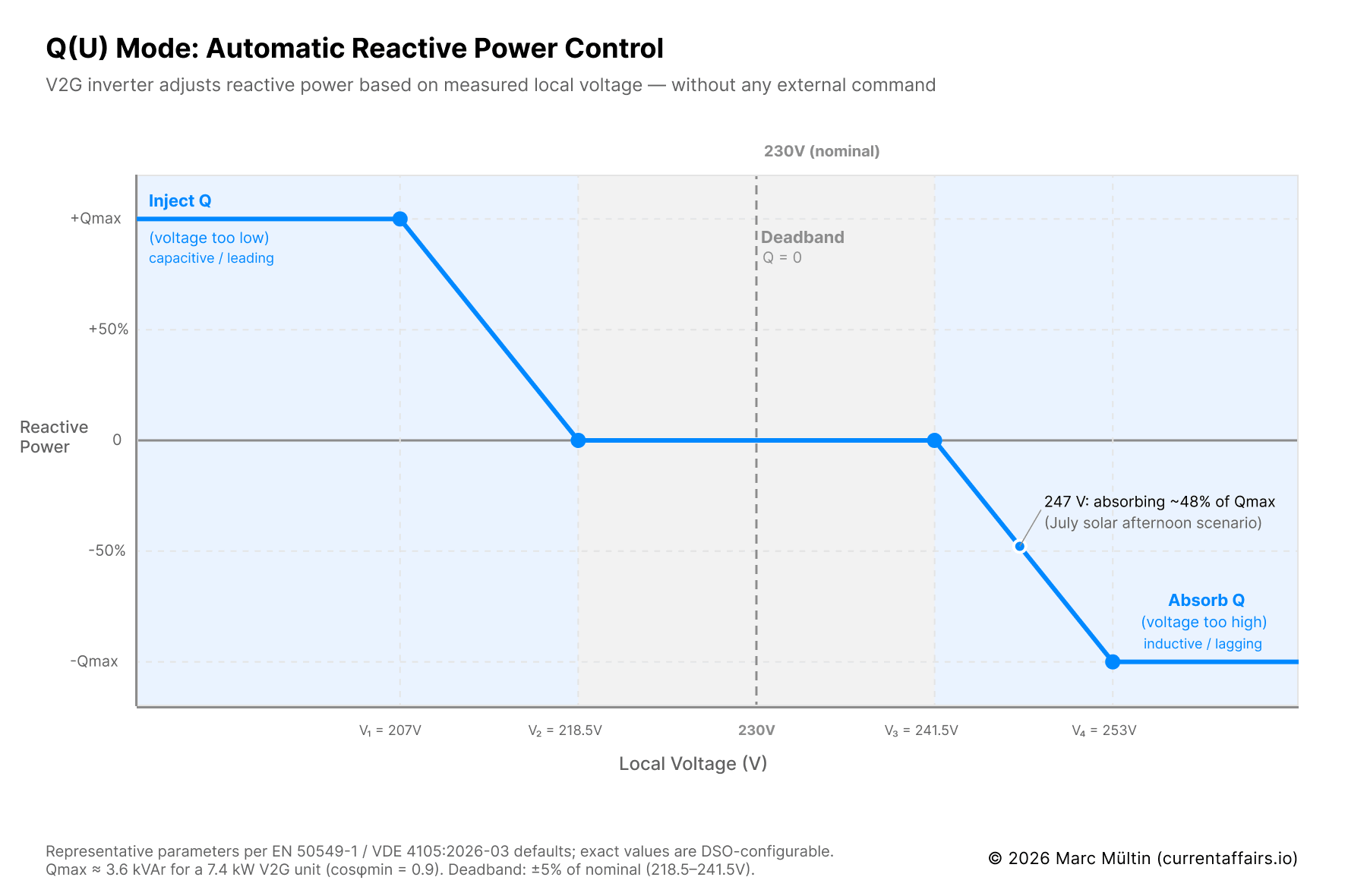
Q(U) mode (fully autonomous, and the most powerful of the four). A note on the notation first: in European power engineering, Q is the standard symbol for reactive power and U is the IEC symbol for voltage (European standards use U rather than V to avoid confusion with the unit volt). Q(U) simply means “reactive power as a function of voltage.”
Reactive power adjusts continuously based on the actual voltage the inverter measures at the socket. When voltage climbs above a threshold, it absorbs reactive power, pulling voltage back down. When voltage dips, it injects reactive power, pushing it back up. No command. No update. Just the inverter reading the voltage and acting.
Within a deadband around nominal voltage — typically ±5%, so 218.5–241.5 V on a 230 V network — the unit does nothing. Normal voltage requires no intervention. The response only activates outside that window.
The exact voltage breakpoints and deadband width are set by the distribution network operator and can be updated remotely — which is precisely what OCPP 2.1’s SetDERControlRequest enables, which we’ll cover in the upcoming article.
In practice: it is a sunny July afternoon, rooftop solar generation is high, and local voltage has climbed to 247 V — 7% above nominal 230 V. Every V2G EV on a home wallbox in the neighbourhood has Q(U) mode enabled. Each one automatically absorbs reactive power, attenuating the voltage rise without anyone issuing a command. By 6 pm when those same EVs begin discharging into the evening peak, the local voltage is already under control. That is distributed voltage regulation. No control centre, no communication overhead, no manual instruction.
A patchwork of national grid codes — converging slowly
The EU-level RfG amendment covering V2G is still progressing through the Commission's comitology process. Mandatory compliance is realistically around 2030. In the meantime, national grid codes govern V2G deployments — and they differ.
The table below represents my best effort to gather accurate data, but if you are an electrical / power engineer and spot an error, then please do reach out.
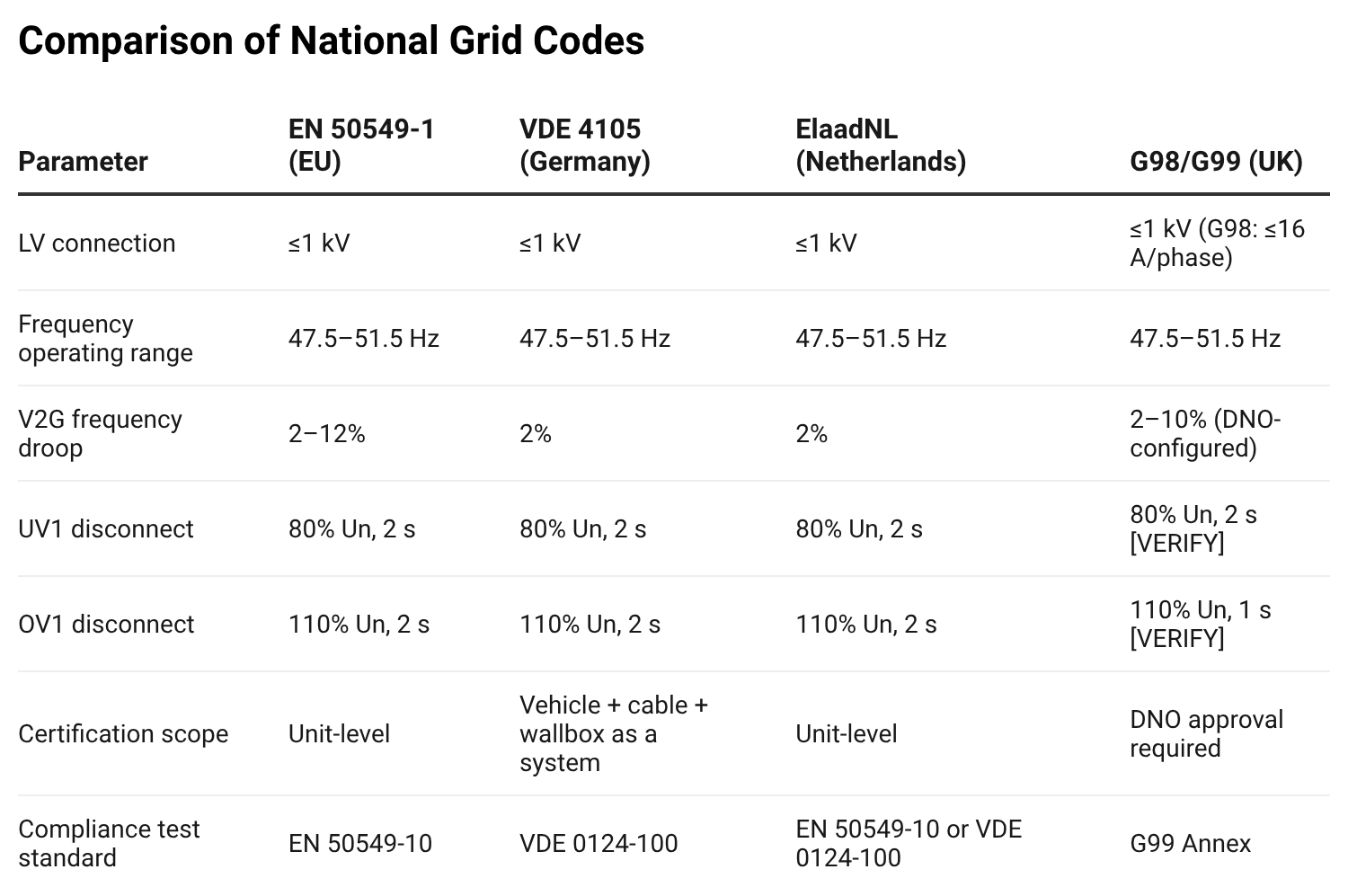
A note on the UK column: G99 Issue 2 (March 2025) extended coverage to storage-based generating units — including V2G — effective March 2026. Unlike Germany and the Netherlands, G98/G99 does not mandate a fixed droop value; the setting is configurable within the 2–10% range, determined by the DNO at connection approval. The voltage trip thresholds marked [VERIFY] should be confirmed against the current G99 Issue 2 text. If you happen to know more details, please let me know.
Germany’s VDE-AR-N 4105:2026-03, effective March 2026, deserves particular attention: it is the first national standard to formally include V2G and V2H requirements, making Germany the first EU country with an active, enforceable V2G grid code. As far as I know, Ford × Octopus and BMW × E.ON are both operating under it today.
One aspect of VDE 4105 stands out: unlike PV inverters — where only the inverter unit needs certification — V2G under VDE 4105 requires certification of the entire functional system: vehicle model, charging cable type, and wallbox model as an integrated unit. A specific Ford Explorer certified with a specific Ambibox wallbox does not automatically certify the same Explorer with a different wallbox. For V2G to scale across millions of vehicles and hundreds of charger models, this system-level certification requirement needs to evolve. It is part of what EU-level RfG harmonisation will eventually need to address. In the meantime: if you have a certified V2G system, cherish it. Don’t even change the cable (never touch a running system, remember?)
A notable point in the Dutch framework: the ElaadNL V2G Implementation Guide 2025 explicitly states that a unit certified under VDE 4105 (with a VDE 0124-100 test report) or Belgian C10/11 (with a C10/26 test report) is accepted as compliant in the Netherlands. This might seem surprising — why would a German national standard satisfy Dutch requirements?
The answer is that VDE 4105, C10/11, and the Dutch framework are all national implementations of the same underlying standard: EN 50549-1. Their core interface protection parameters — voltage trip thresholds, frequency limits — are harmonised to the same values. A device that passes VDE 0124-100 testing has effectively demonstrated compliance with EN 50549-1. The Netherlands recognises this equivalence explicitly, and it is EN 50549’s design working as intended: national codes with minimal technical divergence in the parameters that actually matter for grid safety.
The rulebook is ready. The wiring is almost there.
That, in brief, is where the grid code landscape stands today. I do realise that I’ve been focusing on the UK and EU and left out the US, Australia, or other parts of the globe in this article. Please feel free to reach out to me if you have information on grid codes in these regions and I’ll make sure to include this information in a future post.
V2G turns an EV from a consumer into a generator, and the regulatory apparatus that governs generators is catching up. The RfG provides the legal foundation. EN 50549-1 specifies the technical parameters. VDE 4105:2026-03 enforces them in Germany right now, with BMW × E.ON and Ford × Octopus both operating under it today. Other national codes are converging to the same baseline.
But grid codes on paper don’t configure inverters in cars. Getting those parameters — droop curves, Q(U) profiles, voltage trip thresholds — from a grid operator’s systems into the on-board charger inside a vehicle requires a protocol chain that most of the industry has barely started thinking about.
In the next article, we’ll cover OCPP 2.1’s DER (Distributed Energy Resource) control messages, the last-mile problem from charging station to EV inverter, and why ISO 15118-20 Amendment 1 is the piece that makes dynamic grid code compliance possible at all.
Very good write up Marc. Purchased VDE 4105 for Chademo V2G in the past. Of your stipulations is there anything the combined charger/EV have to comply with that say a 11kW PV inverter doesn’t? Or is all discharging seen similar as PV inverter