
What ISO 15118-20 Amendment 1 changes for AC vehicle-to-grid
An EV that feeds the grid is a generator that needs to follow a rulebook. Amendment 1 is what finally lets an AC-connected one behave like a sanctioned generator the grid operator is willing to pay.

An EV pushing power back into an AC grid is a generator, and grid operators do not let unfamiliar generators onto their networks. They demand each one follow a rulebook: hold steady when the voltage dips, wind back the power it is exporting when the frequency climbs too high, disconnect cleanly when something goes wrong. Until now, ISO 15118-20 had no way to hand an EV that rulebook and let it follow the rules on its own. The 2022 edition of the standard could tell a car, moment by moment, exactly how much power to import or export. What it could not do was make the car behave like a generator a grid operator would certify. That single gap is why AC vehicle-to-grid (V2G) has spent years stuck in pilots: an EV that cannot be certified as a generator cannot be paid as one.
Earlier this month, ISO published Amendment 1 to ISO 15118-20 as an international standard. The full title tells you exactly what it carries: AC DER service, MCS service, and improved security concept. Now anyone building an AC V2G product can read precisely what the car and the charger are expected to say to each other.
I have written a fair amount about the protocol chain behind V2G in this series, most recently in my article on how OCPP 2.1 and ISO 15118-20 enable grid-code implementations. You do not need to have read it (although I invite you to (re-)visit this tech deep dive), and you certainly do not need to remember it. I will re-establish the parts that matter as we go. What I want to do here is walk you through what Amendment 1 actually adds, with most of the attention on the AC DER (Distributed Energy Resource) service. Then I’ll cover the megawatt charging service (MCS) and the security changes more briefly.
In this article, you will learn:
Why the 2022 standard’s existing AC bidirectional service was not enough to make an EV a sanctioned grid asset, and what specifically it lacked
How the new AC DER service lets a charger hand the car a set of grid-code behaviours (e.g. volt-var curves, ride-through profiles, trip rules) that the car then runs on its own
Why there are two AC DER services,
AC_DER_IECandAC_DER_SAE, and what that split means if you build one car for two continentsWhat the new megawatt charging service borrows from DC charging, and what the “improved security concept” actually hardens, including a path to provision contract certificates on EVs with no dedicated security chip
What CharIN’s implementation guides and the IEA’s Task 53 “Golden Guidelines” are doing to turn a flexible standard into interoperable products, ahead of the January 2027 AFIR deadline
Latest articles:
If you haven’t subscribed yet, here’s what was covered in the past weeks:
Where AC V2G actually stands, in one minute
To see why Amendment 1 matters, you need one mental model.
When an EV sends power back to the grid, something has to convert the car’s direct-current (DC) battery into grid-synchronised alternating current (AC). That something is an inverter, and where it physically sits decides who is responsible for behaving well on the grid. In DC vehicle-to-grid, the inverter lives in the charger, so the charger carries the grid-compliance duty and the car is little more than a managed battery. In AC vehicle-to-grid, the inverter is inside the car’s onboard charger. The car itself is the generator on the grid. The charger on the wall or on the street is just an intelligent socket.
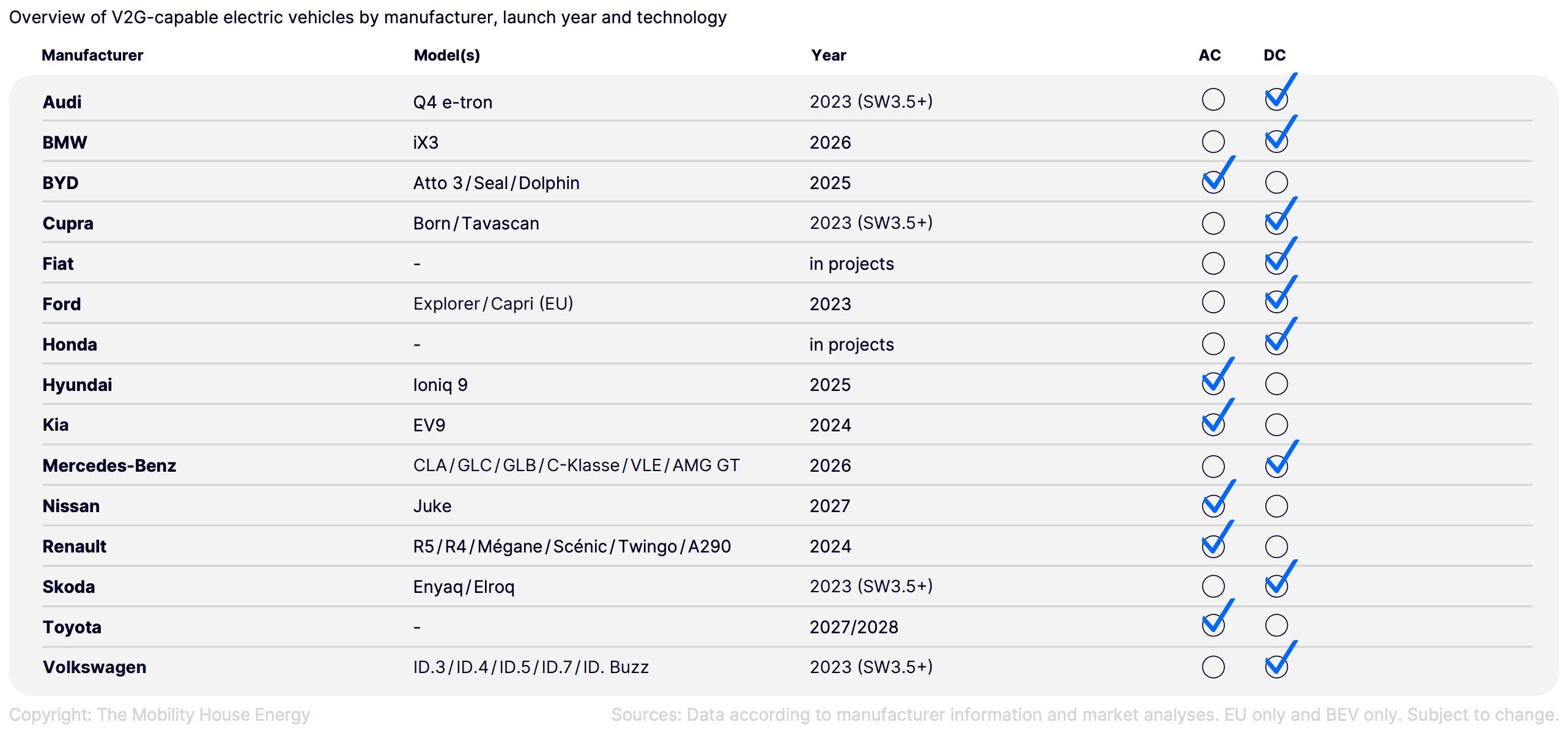
That single fact is why AC V2G is harder to standardise, and it also shapes where the market is heading. Most bidirectional EVs on sale today actually use the DC architecture, with the inverter offboard in the charger or wallbox. The image below shows the current state of V2G capable light-duty EVs being sold in the EU, according to an analysis conducted by The Mobility House.
The long-run cost logic, though, favours AC for mass-market cars according to conversations I’m having with industry peers: a grid-interactive inverter built into a car that is already sold by the million is cheaper per unit than one built into every separate wallbox, which can then stay a relatively simple, cheap socket. Medium- and heavy-duty vehicles are the exception: a DC charger is already an expensive box of power electronics, so making it bidirectional adds relatively little, where that same inverter would dominate the cost of a simple AC socket. The bigger batteries and higher discharge power of medium- and heavy-duty EVs also give the larger V2G cycles utilities value most. A US electric school bus, with its very predictable schedules and long dwell times, is one obvious case; a logistics fleet depot is probably another. DC is likely to hold that segment for longer.
Either way, the moment the inverter sits in the car, the grid operator’s rules about how a generator must behave have to reach the car. They cannot stop at the wall.
Those rules travel down a chain of three hops, which my article on ISO 15118 and OCPP 2.1 covered in detail. A grid or distribution system operator (DSO) sends a signal to an aggregator, or flexibility service provider (FSP). That aggregator can be a fleet operator or charge point operator (CPO) in its own right, or it reaches a CPO’s charge point management system (CPMS) through an API, using a utility-facing protocol such as OpenADR or IEEE 2030.5. The CPMS relays the instruction to the charging station over OCPP 2.1, where Section Q of that specification carries commercial dispatch (the instruction for how much power to import or export, and in which operating mode) and Section R carries the DER compliance parameters (the grid-code rules the car must obey). And then the charging station has to pass those parameters the final metre, over ISO 15118-20, into the car’s inverter.
That final metre is what the 2022 standard left unfinished, and what Amendment 1 completes.
What the 2022 standard could and couldn’t do
Let’s start with what the ISO 15118-20 standard, published in 2022, could already do. It defines bidirectional power transfer as a first-class capability, including an AC variant called AC_BPT (BPT = Bidirectional Power Transfer), and its introduction anticipated EVs being used as distributed energy resources that provide power back to the grid.
AC_BPT already did real work. It let the charger tell the car a target for active power (the real watts that charge or discharge the battery) and a target for reactive power (measured in vars, the component that props up or pulls down grid voltage without transferring net energy), through fields such as EVSETargetActivePower and EVSETargetReactivePower. It even distinguished between a car acting as a grid-following generator, which simply injects power in step with the grid it sees, and a grid-forming one, which sets up its own voltage and frequency. So the car could already push watts and vars in the direction it was told.
The limitation sits in how those commands work. The 2022 model is a setpoint model: the charger continuously commands a value, and the car obeys it. That works when the grid is calm and the communication link is quick. It falls apart the moment the grid condition changes fast. If voltage sags or frequency dips, a real generator is required to respond within milliseconds, following a pre-agreed curve, and to stay connected through the disturbance rather than dropping off and making things worse. A setpoint that has to be recalculated and re-sent over a communication link cannot keep up with that: by the time the fresh instruction arrives, the disturbance it was meant to answer has come and gone.
Search the entire 2022 text and you will find none of the grid-code functions: no volt-var curve, no frequency-droop function, no fault-ride-through profile, no concept of entering or tripping out of service. The car could be told what to do at an instant. It could not be given the rules to govern its own behaviour over the next few minutes of a grid event. That is precisely the gap a distribution system operator cares about, because that is what every rooftop solar inverter and stationary (home or commercial) battery on the network is already required to have.
AC DER: from controllable battery to grid-compliant generator
The centre of Amendment 1 is a pair of new services that close exactly that gap. DER stands for distributed energy resource, the industry’s term for any small generator or storage device connected to the distribution network rather than the transmission backbone: solar panels, wind turbines, home batteries. Amendment 1 simply lets an EV join that club.
The mechanism is a shift in what the charger sends. Instead of only sending instantaneous setpoints, the charger now hands the car a set of grid-code functions, the behaviours a grid operator requires of any generator on its network, at the start of the session, and the car executes them autonomously from then on.
If the artwork at the top of this piece looks like Michelangelo's Creation of Adam, that is deliberate: the grid reaches out, hands the car the rulebook, and the car comes alive as a generator the moment it takes hold of it.
The container that carries those grid codes is called DERControl, described in the standard as holding “all the functions related to the Grid Code that the EVSE sets the EV to run”.
What is inside that container is the vocabulary of every modern interconnection standard, now expressed as things a charger can send to a car:
Volt-var, watt-var and watt-cosPhi curves for reactive-power support: the car varies the reactive power it exchanges as a function of measured voltage, or of the active power it is delivering (ReactivePowerSupportType).
Frequency-watt and volt-watt curves for active-power support: the car automatically raises or lowers the power it exports in response to the grid’s measured frequency or voltage, which is how a generator helps keep the grid at its correct frequency and voltage (ActivePowerSupportType, FrequencyWattType).
Fault-ride-through profiles for over- and under-voltage: instead of tripping off at the first sign of trouble, the car stays connected and keeps supporting the grid through a defined voltage envelope (FaultRideThroughType).
Enter-service and trip rules: the conditions under which the car is permitted to start exporting, and the voltage and frequency limits at which it must stop.
Each curve is sent as a short list of points, between two and ten of them, that the car interpolates into a continuous response (DERCurveType). The useful way to picture it: the old model was a driving instructor in the passenger seat calling out “brake now, accelerate now” over a slightly laggy phone line. The new model hands the driver the Highway Code before they set off, and trusts them to react to the road themselves. For anything that happens at grid speed, only the second approach can work. This is what a network operator needs before it will let millions of cars onto its feeders.
Why there are two: IEC and SAE
Amendment 1 does not define one AC DER service, but two. And there’s a good reason for that. AC_DER_IEC is ServiceID 10 and is built on the European and IEC world, aligned to IEC 61851-1 and grid codes in the EN 50549 family. AC_DER_SAE is ServiceID 11 and is built on the North American world, aligned to IEEE 1547-2018, SAE J3072, and UL 1741.
Those names deserve a word each, because they are the whole reason the split exists.
On the European side, IEC 61851-1 is the base standard for conductive EV charging (Edition 4 adds the hooks for grid-support behaviour), and the EN 50549 series is the European rulebook for connecting any small generator to the distribution grid: the voltage and frequency limits it must respect, and the reactive-power and ride-through behaviour it must provide.
On the North American side there are three, each doing a different job:
IEEE 1547-2018 is the equivalent grid rulebook to EN 50549: the standard that defines how any distributed energy resource, whether a rooftop solar inverter, a home battery, or now a V2G car, must behave electrically once it is connected to the grid.
SAE J3072 is the automotive-specific bridge to it: it lets an EV with an onboard inverter declare and certify that it meets IEEE 1547, so a charger can accept the car as a sanctioned grid resource rather than an unknown box.
UL 1741 is the safety-certification standard the hardware is actually tested and listed against to prove it does what IEEE 1547 requires. Its supplement for AC-coupled systems (supplement C, or SC), where the inverter sits inside the vehicle, is the one that matters for AC V2G.
Two regions, two rulebooks, two certification chains, and now two ISO 15118-20 services to carry them.
The two are close cousins. Both deliver the full set of grid-code curves and trip settings to the car once, during ChargeParameterDiscovery (the parameter handshake before any power flows), and the car then runs them autonomously. Where they differ is who sets the terms.
The IEC service is site-driven: the charging station tells the car which grid-code functions are required at that location, and the car may only proceed if it supports all of them. The SAE service is EV-driven: the car declares which IEEE 1547 functions it supports, the charger enables the subset it wants, and an explicit enter-service permission grants or withholds the right to discharge at that site. The difference reflects the standards beneath them, a compact European function set against IEEE 1547’s more granular one. Both are built on the existing AC service that was already defined in ISO 15118-20 as published in 2022, so an implementer reuses most of their AC_BPT work rather than starting from scratch.
For anyone building a car meant to sell on both continents, this is the part to sit up for. Grid-code compliance is not something you can localise with a software flag at the end. It reaches into how the inverter is certified, and the two services mirror two genuinely different certification regimes. A V2G car is a regulated generator, and so far, every country regulates generators its own way.
Why an EV charging professional should care
Everything above is machinery. Here is the value it unlocks, and it comes down to one word: eligibility. Or to use grid operator terminology: dispatchability.
Dispatchability is the ability of an electricity generation resource (like an EV) to turn on, turn off, or ramp its power output up or down on demand at the request of grid operators – in return for financial compensation.
An AC-connected EV that can only follow setpoints is, from a distribution operator’s point of view, an uncertified load that happens to run backwards. It cannot be enrolled as a sanctioned generator, which means it cannot be aggregated into a virtual power plant, cannot be counted toward a flexibility contract, and cannot be trusted to sit on a feeder unsupervised. No eligibility, no revenue. The last three Current Affairs articles traced how thin the current V2G earnings are and how many gates an asset has to pass before a market will pay it. AC DER is the gate that sits right at the car.
By giving the car the same grid-code behaviours that EN 50549 demands of a home battery and IEEE 1547 demands of a rooftop inverter, Amendment 1 makes it possible, for the first time in a standardised way, to certify an AC-connected EV as a proper distributed energy resource.
That is the precondition for the car to earn from grid services rather than merely dodge peak tariffs. National grid codes, certification bodies and market rules all still have to line up behind it. In Europe the missing piece is RfG 2.0, the awaited update to the EU’s Requirements for Generators network code, which will finally treat a bidirectional EV as a recognised generator and set, at Union level, what one is required to do. RfG 2.0 is the framework on top; EN 50549 is the harmonised standard beneath it that spells out the actual settings, the Q(U) and frequency-droop curves and ride-through limits that national codes such as Germany’s VDE-AR-N 4105 and Britain’s G99 put into force and that AC_DER_IEC then carries into the car. Until RfG 2.0 lands, those requirements stay national and provisional, which is why AC V2G still cannot certify once and sell across the continent. But without the mechanism in the car, none of the rest can connect to anything. Amendment 1 is that crucial, enabling mechanism.
MCS: reusing the DC stack for megawatt trucks
The economics of an electric long-haul truck come down to how long it stands still. Under EU rules a driver must break for 45 minutes after four and a half hours at the wheel, so a truck that can refill a leg’s worth of range inside that window loses almost no time to charging. That is the number the Megawatt Charging System (MCS) is built to hit. A heavy truck carries around a 600 to 1,000 kWh battery, roughly ten times a car’s; at around 1.2 MW, the energy for another four-and-a-half-hour leg comes back in about 45 minutes. To move that much power, MCS reaches up to 3,000 A at 1,250 V, close to 3.75 MW, far beyond anything a car connector is built to carry. Amendment 1 brings this into ISO 15118-20 as two new services, MCS (ServiceID 8) and MCS_BPT (ServiceID 9) for the bidirectional case.
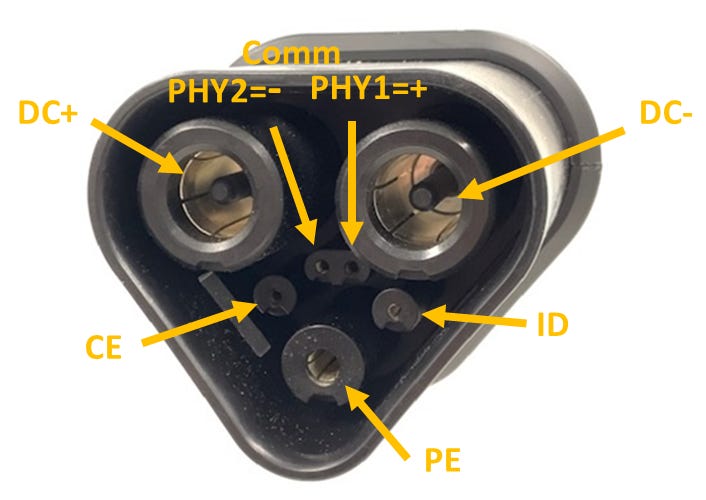
The clever decision is how little was invented. The amendment states outright that the two services “are derived from the DC and DC_BPT service and will use the DC schema for the messages”. At the application layer, megawatt charging is DC charging reused: the same parameter-discovery, cable-check, pre-charge, charge-loop and welding-detection flow that DC already had. Reusing a proven message set instead of designing a fresh one is how you avoid a decade of interoperability bugs.
What genuinely changes is underneath. Megawatt charging swaps the physical layer, moving from the powerline communication that CCS uses over its charging cable to single-pair Ethernet, specifically 10BASE-T1S, defined in the new ISO 15118-10:2025 that Amendment 1 now references normatively. The session and enable signalling is aligned to IEC 61851-23-3, and the service is deliberately clean: backward compatibility with the older ISO 15118-2 is explicitly not implemented for a megawatt charging session. No legacy baggage, a new communication medium, an old and trusted message set on top.
In May last year, CharIN published a white paper that gives an overview of several technical and non-technical aspects of the Megawatt Charging System (MCS). Click the download button below to learn more.

If you build for cars, you can file MCS as good news that does not concern you today. If you build for trucks, depots or high-power corridors, it is the moment ISO 15118-20 formally became your standard too.
Improved security: hardening the plumbing
The third addition is the one most likely to be misread, so let me be precise about it. The headline “improved security concept” does not mean a new cryptographic foundation. The 2022 standard already mandated TLS 1.3, the current version of the protocol that secures the connection, and moved to stronger cryptography than the older ISO 15118-2 (which was first published in 2014), including the larger secp521r1 elliptic curve and a raised certificate size limit. Amendment 1 does not touch the TLS version. What it does is harden the plumbing around certificates, which is where real deployments actually struggle.
Three of the changes are worth knowing about, even at a high level:
First, the amendment tightens certificate handling for constrained devices. It reaffirms the 1600-byte ceiling on a certificate and adds pointed guidance to stay under it, warning implementers to be careful with long URLs and to consider including only one of two optional revocation-pointer fields rather than both. That sounds fussy until you remember the receiving device is a low-cost embedded controller inside a car, with little memory and a hard real-time budget. It also adds a rule that a certificate must be valid only within the validity window of the certificate that issued it, closing a gap where a leaf certificate could outlive its parent.
Second, it expands cross-certification, the standard’s native way to let an EV homed under one V2G root certificate authority charge under another: a car carrying only a German V2G root can be accepted at a station whose certificate traces to a French one, provided the two roots cross-sign each other. Amendment 1 nearly doubles the treatment, adding placement rules, worked topologies up to a three-root case, and a longer weighing of the advantages, disadvantages and risks. That last part is the tell. Cross-certification is hard to run at scale, because every new pairing is a bilateral arrangement and the trust risk grows with each extra link in the chain. The standard only “opens the door” to it, in its own words it “neither mandates nor prevents” it, and Europe has chosen the simpler path.
The EU’s Sustainable Transport Forum, together with CharIN, is building a single central Certificate Trust List of trusted roots, maintained centrally under the Commission’s Joint Research Centre in Ispra. One signed list that every party reads is far easier to operate than a mesh of roots cross-signing each other pair by pair, a combinatorial headache that grows with every new root certificate authority added. That is why the CTL is the EU’s way forward, and likely the template other regions adopt.
Third, it makes provisioning a contract certificate onto an EV that has no dedicated security chip a first-class case. The 2022 design leaned on a Trusted Platform Module, a hardware security element, to protect private keys, though it never strictly required one. Not every vehicle ships a TPM, and the chips have had long supply lead times. Amendment 1 formalises the alternative: it explicitly scopes the certificate-provisioning path for vehicles without a TPM and adds a lighter-weight key variant, with the private key encrypted using strong symmetric cryptography and delivered inside a dedicated field. For anyone worried about how quickly Plug & Charge can reach the mainstream fleet, that is a meaningful widening of the door.
None of these changes is glamorous, but they are what makes a security design hold up outside the lab, once it meets millions of cheap embedded devices and competing certificate authorities.
Closing the interoperability gap
Publishing a standard is one thing; getting two independently-built products to interoperate is another. ISO 15118-20 deliberately leaves implementers room: it supports many use cases, marks some parameters optional, and often offers more than one way to reach the same result. That flexibility is deliberate: leaving parameters optional and several valid ways to do the same thing is how one standard covers many use cases and wins agreement across carmakers, charger vendors and utilities. The bill lands later, on the engineers, because two products can each conform to the standard in full and still make different, equally valid choices that stop them talking to each other. Early implementations have already diverged, most painfully in the service-selection phase, where the two sides settle what they are about to do.
CharIN, the industry body behind the CCS connector, is closing that gap with a series of implementation guides: deliberately reduced, explicit, testable subsets of the standard that give everyone a common baseline to build and test against. The approach was proven on the DC bidirectional guide, and an AC charging guide for ISO 15118-20 is now in progress, led by Mercedes-Benz and EcoG, with publication targeted for later this year, ahead of the EU AFIR (Alternative Fuels Infrastructure Regulation) deadline. Its first version keeps the scope deliberately tight: plain AC charging in dynamic control mode, with AC_BPT and the new AC DER services held back for a follow-up guide built on Amendment 1. A separate MCS implementation guide, also based on Amendment 1, is expected around the turn of Q3 into Q4.
CharIN is not the only body at this: the IEA’s Task 53 initiative, spanning eighteen countries, is drafting “Golden Guidelines” that fix a mandatory interoperable subset of ISO 15118-20 for V2G, starting with an initial subset that drops the optional fields and mandates TLS 1.3 and dynamic mode, with the complete guidelines not due until around 2028. Between them, they narrow a standard that allows many valid implementations down to the common, testable subset that lets independently-built products interoperate.
The bottom line
Read the three additions together and they point the same way. ISO 15118-20 launched in 2022 as a capable but unfinished standard: it could move power in both directions, but it could not yet make an AC-connected car a sanctioned generator, could not serve megawatt trucks, and left a few sharp edges in its certificate handling. Amendment 1 is the standard being finished into the thing the market actually needs.
The AC DER service is the piece that matters most for where this series has been heading. It is the mechanism that lets the car carry the grid’s own rules, which is the precondition for an AC-connected EV to be certified, aggregated and paid as a distributed energy resource rather than tolerated as a load. The mechanism is now published. What has to catch up is everything around it: national grid codes, the RfG 2.0 update, certification schemes, and the interoperability work that pins down a common subset so that every carmaker and charger manufacturer implements the same dialect. The AFIR mandate that brings ISO 15118-20 to new EU public chargers from 1 January 2027 sets the clock. Amendment 1 makes sure that when the rest arrives, the car will already know how to listen.
Enjoyed this deep dive?
Then please share with your professional (social) network
and restack for your readers.